 SmartHub
 Automation
 Appointment Scheduler
 Lead Management
 Dashboard & Reports
 Task Management
 Communications Hub
 Managed chat
 Voice Receptionist
 Appointment scheduling
 Retainer signing
 Home services
 Lawyers and firms
 Medical services
 College admissions
 Real estate agents
 Marketing agencies
 About
About Partner program
 Estimate Your ROI
 Case Studies
 Blog
Blog FAQs
FAQs Login
LoginRunning Healthcare Call Centers with AI Voice Agents




Products
Industries
Company
Resources

It's 8 PM and a patient calls with a prescription question, but the front desk closed hours ago. That time mismatch between patient needs and office hours is exactly why healthcare call centers exist. Healthcare calls carry different stakes than typical customer service and AI voice agents now handle defined tasks while staff stay ready for the rest.
A healthcare call center handles a mix of administrative, scheduling, patient-support and routing calls, such as:
These call types carry different urgency levels and different staff requirements, so a physician practice or specialty clinic often needs different handling for a refill request than for a symptom call heading to a nurse line. Call volume for call centers for healthcare swings hard around flu season, insurance renewal periods and provider schedule changes.
Patients call outside normal office hours just as often as during the day and keeping human staff available 24/7 creates significant staffing and operating costs for any call centers for healthcare setup.
Coverage has to stretch across business hours, nights, weekends and holidays and call volume rarely stays flat. Flu season can push scheduling calls up sharply within days. Staffing for that swing means hiring ahead of peaks nobody can predict months out, then covering slower weeks with the same payroll. Training adds another layer, since a new hire needs weeks of practice before handling billing or triage calls without support.
When a call arrives after the front desk closes, it usually goes to voicemail. Patients call back the next morning, sometimes more than once and a scheduling request from overnight gets buried under the day's regular calls before anyone routes it correctly.
Healthcare call center work wears on people fast. High call volume, emotional patient conversations and difficult billing disputes stack up across a single shift. Physician groups and clinics often name these front-desk roles among the hardest to keep staffed, especially during a hiring crunch.

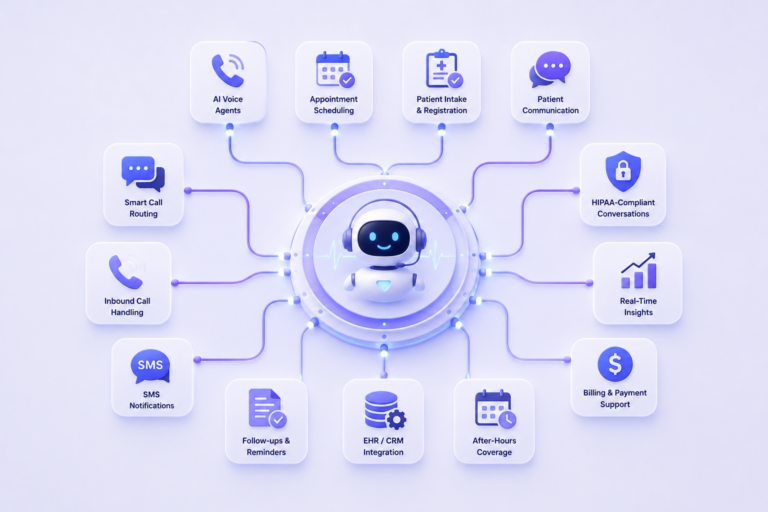
AI voice agents can handle defined administrative and routing tasks, especially during hours when human staff are unavailable or already occupied with patients at the front desk. Appropriate responsibilities for AI for healthcare call centers include:
At Blazeo, after-hours call data from current healthcare accounts shows most calls without a staff member on the line still get logged and routed correctly, with flagged calls typically reaching a human within a few minutes. This reflects Blazeo's own account data, not an industry-wide figure. For practices exploring voice AI for healthcare call centers, this kind of after-hours logging often pairs with an AI chatbot for healthcare handling web-based questions, or online scheduling automation keeping appointment slots in sync.
AI voice agents should not stand in for clinical judgment or situations that call for human discretion and that boundary matters as much for trust as it does for safety on any voice AI for healthcare call centers line;
A responsible AI workflow recognizes its own limits, flags the need for a person and routes the call to the right queue. Where the system supports it, relevant call context carries over, so a patient does not repeat the same details twice. Compliance depends on the specific implementation, vendor agreements and safeguards a practice puts in place, not on the presence of AI by itself. HIPAA relevance depends entirely on how a system is configured and contracted, not on the technology alone.
Small physician practices weigh different factors than a large health system evaluating healthcare call centers for doctors. We've seen practices pick a system meant for a much larger operation, then struggle to justify the cost. Call volume, budget, existing staff and current scheduling software all shape what setup actually fits, whatever the practice's size.
Cost depends on call volume, number of lines, hours of coverage and how much integration work a practice needs. A single-provider office with modest call volume needs a lighter setup than a multi-location group running several phone lines at once. Specific pricing depends on the vendor and scope, not a flat industry rate.
Integration determines whether AI sees current appointment availability or works from a separate, disconnected calendar. Without it, a slot booked in the AI system might not match what a front-desk staffer sees minutes later. Compatibility varies by EHR and scheduling platform, so a practice should confirm the specific integration before committing to a vendor.
Staff need clarity on when AI handles a call, when it escalates and where an escalated call lands in their queue. The handoff should show what information the AI already gathered, so a staff member picks up mid-conversation instead of starting over. A clear handoff matters more than the AI system itself.
Healthcare call centers juggle several call types at once and round-the-clock staffing is hard to sustain without support. AI voice agents can pick up calls that don't need a clinician or trained agent, freeing staff for work that needs judgment and direct patient contact. The same logic applies to customer support call centers for healthcare shaped by clear escalation and solid integration.
Will a patient know they're talking to an AI voice agent instead of a person?
Disclosure depends on the specific implementation and any applicable state or organizational requirements. Most healthcare practices identify AI voice agents clearly at the start of a call, since misleading a patient about who they're speaking with undermines trust.
Can an AI voice agent tell the difference between an urgent call and a routine one?
AI can classify calls using configured questions and routing rules, flagging likely urgent situations for faster escalation. It isn't unrestricted medical judgment, though, so any call suggesting a clinical emergency still routes to a nurse line or provider.
What happens to a call the AI can't handle?
The system routes the call to a staff member or the appropriate queue and where supported, passes along relevant call context. That way, a patient explains their situation once instead of repeating details to whoever picks up next.
Is patient information safe when an AI voice agent answers the call?
Safety depends on the vendor's security practices, access controls and contractual agreements, not on the presence of AI alone. No AI system is automatically compliant with healthcare privacy requirements; that depends entirely on how it's implemented and governed.
Can a small practice afford AI call coverage, or is it only for large health systems?
Suitability depends on call volume, required features, integrations and operating hours rather than practice size alone. A single-provider office with modest call volume often needs a lighter, less expensive setup than a multi-location health system.
Does adding AI voice agents mean cutting call center staff?
Not in most operational models. AI typically handles defined, repetitive calls like appointment confirmations or refill requests, while staff focus on escalations, sensitive conversations and requests that need judgment a script can't provide.
How does an AI voice agent know which calls to send straight to a nurse line?
Routing relies on predefined questions, keywords and workflow rules configured for that practice, not independent clinical decision-making. A call mentioning specific symptoms or distress typically triggers a route straight to a nurse line or on-call provider.
Can patients still reach a live person if they'd rather not use the AI line?
Yes, when the organization builds that option into its call flow and staffing model. Most implementations include a direct path to a human, either immediately or after a short set of routing questions.

