 SmartHub
 Automation
 Appointment Scheduler
 Lead Management
 Dashboard & Reports
 Task Management
 Communications Hub
 Managed chat
 Voice Receptionist
 Appointment scheduling
 Retainer signing
 Home services
 Lawyers and firms
 Medical services
 College admissions
 Real estate agents
 Marketing agencies
 About
 Partner program
 Estimate Your ROI
 Case Studies
 Blog
 FAQs
 Login
Prospective Clients, Conflicts, and the Intake Sequence




Products
Industries
Company
Resources

A prospective client contacts a law firm about a dispute with a former business partner. They are frustrated, concerned about their legal options, and eager to explain what happened. Within minutes, they begin sharing financial information, private correspondence, and details about negotiations that have already taken place.
The intake representative listens, asks follow-up questions, and records everything for the attorney.
Only later does the firm discover that it already represents the other party.
What initially appeared to be a thorough intake conversation has created a potentially complicated professional responsibility issue. The firm has received information from someone seeking representation before determining whether it can consider taking the matter.
This is why the sequence of legal intake matters as much as the information collected.
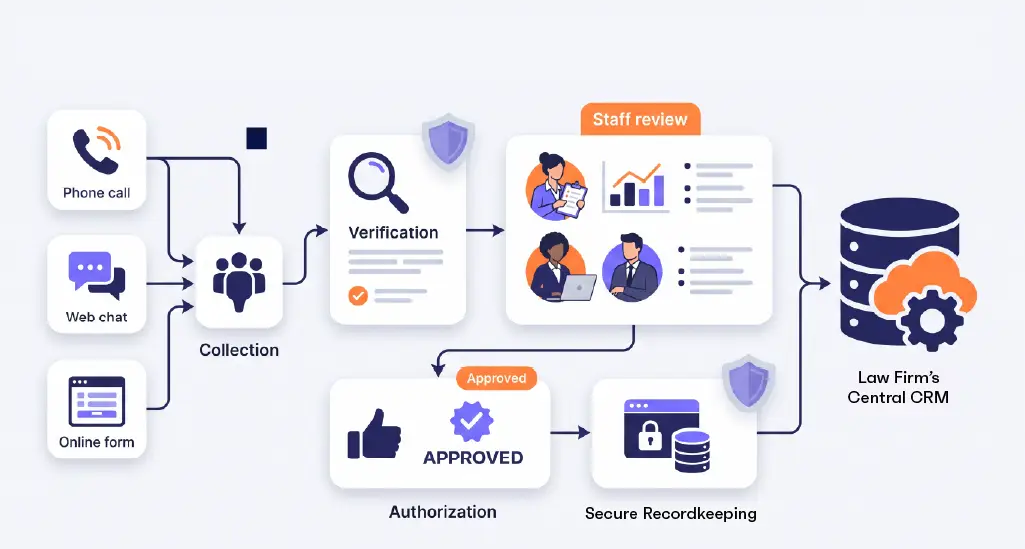
An effective legal intake conflict screening process does not begin with a detailed account of the prospective client's problem. It begins by establishing who is contacting the firm, who else is involved, and whether the firm can safely proceed to a more substantive conversation.
For law firms managing inquiries across phone calls, website forms, live chat, and after-hours channels, that distinction has significant operational consequences. The challenge is not simply collecting information efficiently. It is making sure information enters the firm in the right order, through the right people, and under the appropriate controls.
A common misconception about legal intake is that professional obligations begin only after a firm agrees to represent someone.
In reality, certain duties can arise much earlier.
Under the American Bar Association's Model Rule 1.18, a person who consults a lawyer about the possibility of forming a client-lawyer relationship may qualify as a prospective client, even if the relationship never materializes.
The rule also restricts the use or disclosure of information learned during such consultations. In certain circumstances, receiving information that could be significantly harmful to the prospective client may prevent a lawyer, and potentially the lawyer's firm, from representing someone with materially adverse interests in the same or a substantially related matter.
These consequences are not automatic in every inquiry. Whether a person qualifies as a prospective client, what information was received, and whether disqualification applies depend on the facts and applicable jurisdiction.
Nevertheless, the underlying operational lesson is important: a firm should not assume that an initial conversation is free of professional responsibility considerations simply because no engagement agreement has been signed.
The ABA's Formal Opinion 492 further addresses lawyers' obligations when dealing with prospective clients, including the importance of limiting the information received during preliminary consultations.
For intake teams, this changes the purpose of the opening conversation. Rather than encouraging callers to explain everything immediately, the process should establish enough context to determine what happens next.

The first stage of a well-structured prospective client intake process should focus on identifying the people and organizations involved.
Consider a caller who says they need help with an employment dispute.
An inexperienced intake representative might immediately ask what their employer did, how long the conduct continued, and whether they have documentation supporting their allegations.
A more controlled approach begins with basic identifying information: the caller's name, contact details, the employer's legal name, and any other parties whose identities are necessary for the firm's preliminary conflict-screening process.
The representative may also need a broad matter category, such as employment discrimination, wrongful termination, or a contractual dispute, to direct the inquiry appropriately.
At this stage, the objective is not to evaluate the claim. It is to establish enough information to identify relevant parties and determine which internal workflow applies.
This distinction becomes particularly important when callers are emotional or anxious. Someone seeking legal help may reasonably believe that providing more detail will improve their chances of receiving assistance.
The intake representative must therefore explain why the conversation is being structured differently.
A simple statement can establish that boundary: "Before we discuss the details, I need to collect some basic information so our team can complete its initial review."
That explanation makes the process feel deliberate rather than dismissive.
It also reduces the likelihood that a caller will interpret limited questioning as a lack of interest.
More information is not always better information, particularly when a firm has not yet established whether it can proceed.
Imagine a commercial litigation firm receiving an inquiry from a business owner involved in a shareholder dispute. During the first call, the individual shares internal financial projections, confidential settlement discussions, and concerns about another shareholder's negotiating position.
The firm subsequently discovers that the shareholder is an existing client.
The problem is no longer limited to declining the new engagement. The firm must assess whether the information received creates additional restrictions under the applicable professional conduct rules.
The ABA's Comment 4 to Rule 1.18 advises lawyers to limit initial consultations to information reasonably necessary to determine whether to represent a prospective client.
That principle provides a useful foundation for intake design.
A firm does not necessarily need the complete history of a dispute to identify the parties involved, understand the broad practice area, and initiate conflict screening.
It may need only a short, neutral matter description.
For example, "dispute concerning ownership of a privately held company" may provide sufficient initial context without requiring the caller to reveal privileged communications, confidential business strategy, or sensitive allegations.
The appropriate threshold depends on the firm's practice, the nature of the inquiry, and its approved procedures.
The operational objective remains consistent: collect what is necessary for the current decision, not everything that might eventually be useful.
This is also where structured intake technology can support professional judgment. Blazeo offers AI-enabled and live-agent customer engagement capabilities that firms can evaluate for initial inquiry capture and routing. Any legal intake deployment should be configured around firm-approved questions, information limits, and escalation rules rather than unrestricted conversational discovery.
Also read: How AI Receptionist for Law Firms Handles Calls From First Ring to Client Intake
Once the necessary identifying information has been collected, the inquiry should move into the firm's designated conflict-screening workflow.
This is more than searching a database for a matching name.
A meaningful law firm conflict check may require reviewing current and former client relationships, related entities, opposing parties, corporate affiliations, and other connections relevant to the proposed matter.
The scope of that review depends on the applicable professional conduct rules and the firm's policies.

Under ABA Model Rule 1.7, conflicts involving current clients may arise where representation is directly adverse to another client or presents a significant risk of material limitation.
Model Rule 1.9 addresses duties to former clients, including restrictions involving the same or substantially related matters.
These rules illustrate why a basic name search should not automatically be treated as clearance to proceed.
A conflict may involve an affiliated company, a former client, or a relationship that is not immediately apparent from the caller's initial description.
For instance, a prospective client may identify a parent corporation as the opposing party, while the firm's existing relationship is with one of its subsidiaries. Whether that relationship creates a conflict requires appropriate review rather than an assumption based on separate legal names.
A structured workflow should therefore distinguish between collecting information for screening, conducting the screening, and authorizing the next stage of intake.
The intake representative's role is to initiate the process, not independently decide whether a potential conflict is legally significant.
That decision belongs with the attorney or other appropriately authorized personnel under the firm's policies.
One of the most important moments in the legal client intake process is the transition from preliminary screening to a detailed discussion.
That transition should not happen simply because an intake form has been completed or a database search returned no obvious matches.
Instead, the firm needs a defined authorization point.
Depending on its procedures, this may involve an attorney reviewing the conflict results, confirming that additional information can be collected, or directing the matter to a designated practice group.
If a potential conflict is identified, the inquiry should follow the firm's escalation process. That might mean pausing substantive questioning while an attorney evaluates the relationship, determines whether further review is necessary, and considers any legally available consent or screening measures.
The ABA's Formal Opinion 510, issued in March 2024, reinforces the importance of taking reasonable measures to avoid exposure to unnecessary disqualifying information. It also explains circumstances in which appropriate screening and other safeguards may prevent a prospective-client conflict from being imputed to the entire firm.
These protections are subject to specific requirements and are not a substitute for an effective preliminary process.
Once the firm authorizes the next stage, substantive intake can address the facts, relevant documents, desired outcomes, deadlines, and other information needed to evaluate the proposed engagement.
Even then, intake should not be confused with an agreement to represent the person. Engagement decisions, scope, and communication of acceptance remain separate responsibilities.
Also read: Legal Intake Call Center: How Law Firms Handle More New Client Calls
The sequencing challenge becomes more complicated when inquiries arrive outside normal office hours.
A prospective client may contact a firm on Saturday evening about an urgent commercial dispute. Another may submit a website form shortly before a filing deadline. Someone else may reach an answering service when no attorney is immediately available.
The firm still needs to respond, but responsiveness should not mean abandoning its intake controls.

Research from Clio's 2024 Legal Trends Report highlights the broader accessibility problem. In a secret-shopper study involving 500 law firms, only 40% answered phone inquiries, while 48% were effectively unreachable by phone, meaning they neither answered nor returned the test calls.
These figures measure accessibility, not conflict-screening compliance. However, they illustrate the pressure firms face to capture inquiries consistently.
An after-hours workflow should be capable of acknowledging the inquiry, collecting approved preliminary information, and directing it to the appropriate internal queue without encouraging unnecessary disclosure.
If the caller mentions an imminent deadline, the process should flag the urgency immediately. But that does not mean the representative should promise legal assistance, assess the merits, or suggest that the firm has accepted responsibility for the matter.
A properly designed escalation pathway can alert designated personnel while maintaining the boundaries of the preliminary conversation.
Blazeo's customer engagement solutions can be considered as part of this initial contact and routing infrastructure, particularly where firms need consistent handling across live-agent and automated interactions.
The essential requirement is that the technology follows the firm's approved legal intake sequence rather than allowing the conversation to expand without defined limits.
A firm may have a carefully trained receptionist who understands conflict-screening requirements, yet operate a website form that asks prospective clients to describe their entire legal problem.
That inconsistency can undermine the purpose of the intake policy.
The same problem may occur when live chat representatives ask more detailed questions than telephone staff, or when an AI-powered intake assistant continues requesting information after a caller has disclosed the identities needed for screening.
Each channel may appear effective individually, but the overall process lacks consistency.
A reliable law firm prospective client intake process should apply the same core restrictions regardless of how the inquiry arrives.
Website forms should avoid open-ended requests for confidential narratives before appropriate warnings and screening procedures. Telephone scripts should establish boundaries early. Live chat and automated conversations should collect approved fields and stop or escalate when a matter falls outside their permitted scope.
This does not require every channel to use identical wording.
A telephone conversation naturally differs from a digital form. What matters is that both follow the same decision sequence and respect the same information boundaries.
For firms using AI-assisted intake, this also requires deliberate configuration and supervision. The system should not independently improvise legal screening criteria, determine that a conflict has been cleared, or continue into substantive questioning simply because the prospective client volunteers additional information.
The firm should also establish how transcripts, recordings, and submitted materials are accessed, retained, and reviewed. A process designed to limit unnecessary disclosures should not inadvertently distribute sensitive information across unrestricted internal systems.
Technology can make intake more consistent, but only when the underlying rules are clearly defined.
Also read: Why Your Firm Needs Better Legal Client Intake Software Now
A well-structured workflow should make it possible to reconstruct how an inquiry was handled.
Suppose a prospective client later alleges that they disclosed confidential settlement information during an initial conversation. The firm needs to determine when that information was received, who had access to it, and whether the intake representative followed the approved procedure.
Similarly, if a conflict was identified after substantive intake began, the firm should be able to establish whether the problem originated in incomplete party identification, delayed screening, or an unauthorized progression to detailed questioning.
This requires more than storing a completed intake form.
The firm needs appropriate records of the information collected, the stage at which it was collected, the screening decision, and the authorization to proceed.
Where automated workflows are involved, version-controlled scripts and documented escalation rules can help identify whether a configuration change contributed to an error.
Review should also lead to improvement.
If representatives repeatedly receive unnecessary information during the opening conversation, the firm may need clearer scripts or better training. If inquiries routinely stall after preliminary screening, responsibility for the next decision may be unclear.
These reviews help firms distinguish isolated mistakes from structural weaknesses.
The objective is not to turn every intake interaction into an administrative burden. It is to establish enough visibility that the firm can demonstrate how its procedures operate and correct them when necessary.

Conflict screening is sometimes treated as an obstacle between the prospective client and the legal assistance they need.
But a structured opening conversation can actually improve the experience when it is communicated properly.
People contacting a law firm are often dealing with uncertainty. They may be worried about deadlines, financial exposure, family circumstances, or the consequences of a dispute.
They need to know that their inquiry has been received and that someone will explain the next step.
A representative who immediately asks for an extensive account may appear helpful, but that approach can create expectations the firm is not yet in a position to meet.
By contrast, an intake representative who explains the preliminary review, collects limited information, and provides a realistic next step establishes a clearer relationship from the beginning.
Clio's 2024 secret-shopper research found that only 36% of the firms reached by telephone explained the legal process or outlined next steps. That finding points to an important service opportunity: firms can improve the initial experience through clearer communication without prematurely entering into substantive legal discussions.
For example, telling a caller that their information has been forwarded for conflict review and that the firm will contact them after the appropriate assessment is more useful than vaguely promising that an attorney will be in touch.
Where deadlines are involved, the firm should also communicate any limitations of the initial contact and avoid creating the impression that representation has begun.
A good intake experience is not defined by how much information the caller shares. It is defined by whether the person understands what is happening, what has and has not been agreed, and what comes next.
Also read: AI-Driven Legal Intake Funnels: 7 Must-Know Benefits
The central question for law firms is not whether they should collect enough information to evaluate potential clients. Of course they should.
The question is when that information should be collected, who is authorized to receive it, and what must happen before the conversation progresses.
Beginning with identity and conflict-related details creates an opportunity to identify potential problems before sensitive information enters the firm unnecessarily.
Limiting preliminary matter descriptions reduces exposure while still allowing appropriate routing. A defined conflict-screening stage places legal judgment with authorized personnel. And a controlled transition into substantive intake ensures that detailed information is collected under the firm's approved process.
Together, these practices make intake more than an administrative function. They turn it into a practical component of professional responsibility, client communication, and operational risk management.
For firms managing increasing inquiry volumes across multiple channels, consistency becomes particularly important.
Blazeo can help law firms build a more responsive front end to their intake operations through AI-enabled and live-agent engagement capabilities that support initial inquiry capture and routing. Combined with firm-defined conflict-screening procedures and attorney oversight, these capabilities can help create a more consistent intake experience without sacrificing necessary professional boundaries.
Explore Blazeo's solutions to see how your firm can improve initial inquiry handling while keeping the appropriate legal decisions in the hands of its professionals.

