SmartHub
 Automation
 Appointment Scheduler
 Lead Management
 Dashboard & Reports
 Task Management
 Communications Hub
 Managed chat
 Voice Receptionist
 Appointment scheduling
 Retainer signing
 Home services
 Lawyers and firms
 Medical services
 College admissions
 Real estate agents
 Marketing agencies
 About
About Partner program
 Estimate Your ROI
 Case Studies
 Blog
Blog FAQs
FAQs Login
LoginHybrid Customer Support: Why Businesses Are Moving Beyond Traditional Live Chat




Products
Industries
Company
Resources

A visitor lands on your website at 11:47 PM.
They've spent ten minutes reading your pricing page. They've compared plans, browsed case studies, and opened your contact form twice without submitting it.
Finally, they click the chat widget.
"Can someone tell me if this integrates with Salesforce?"
No one responds.
By morning, the prospect is gone.
This scenario plays out thousands of times every day across industries. Businesses invest heavily in advertising, SEO, social media, and lead generation, only to lose qualified prospects at the exact moment they are ready to engage.

For years, live chat was presented as the solution. Add a chat widget to your website, assign a few agents, and watch conversions improve.
It worked—for a while.
But customer expectations have changed. Buyers no longer distinguish between business hours and after-hours. They don't care whether your team is online. They expect answers immediately.
At the same time, businesses face a different challenge: staffing every conversation around the clock is expensive, inefficient, and often impossible.
This is why companies are moving beyond traditional live chat and embracing a new model: AI and human customer support working together.
The future isn't AI replacing people. It's AI and people complementing each other.
And that distinction is changing the way businesses capture leads, serve customers, and generate revenue.
What Is Hybrid Customer Support?
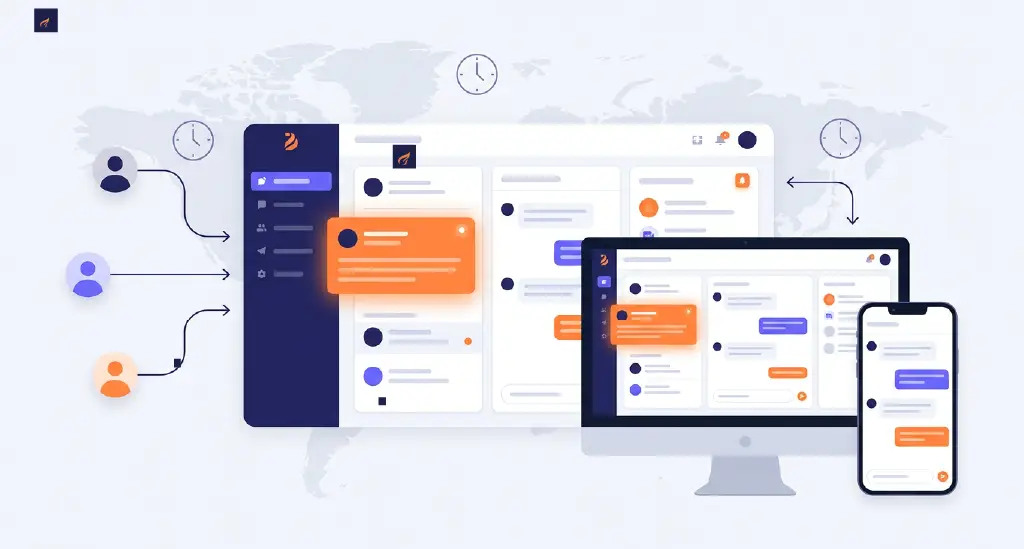
Hybrid customer support combines artificial intelligence and human agents to deliver faster, more personalized customer service. AI handles routine questions, lead qualification, and after-hours engagement, while human representatives manage complex conversations that require expertise, empathy, and decision-making.
When live chat first became mainstream, it solved an important problem.
Instead of forcing visitors to fill out forms and wait for callbacks, businesses could engage prospects in real time.
The concept was simple and effective.
But traditional live chat was built around one assumption: a human would always be available to respond.
That assumption no longer holds true.
Modern websites generate conversations at all hours. Traffic arrives from different time zones. Marketing campaigns run continuously. Prospects conduct research during evenings, weekends, and holidays.
Human agents, however, cannot be online all the time.
As businesses grow, the limitations become increasingly obvious.
Response times slow down during busy periods. Agents become overwhelmed by repetitive questions. Qualified prospects wait in queues. Teams spend valuable hours answering the same inquiries repeatedly.
Meanwhile, customers compare every interaction to the experiences delivered by companies like Amazon, Uber, and Netflix—brands that have trained consumers to expect instant responses.
A visitor who waits ten minutes for an answer today experiences that delay very differently than they would have five years ago.
In many cases, they simply leave.
The result is a support and sales channel that often fails precisely when businesses need it most.
Also read: What Top Teams Know About Live Chat for Lead Generation

The rise of AI live chat for business isn't happening because companies want fewer human interactions.
It's happening because businesses need a way to engage every visitor immediately.
Artificial intelligence solves a fundamental challenge that human-only teams cannot.
It never sleeps.
An AI-powered chat assistant can respond instantly at midnight, during holidays, or when support teams are handling multiple conversations simultaneously.
More importantly, modern conversational AI is no longer limited to scripted responses.
Today's systems can understand intent, ask follow-up questions, qualify leads, provide product information, schedule appointments, route inquiries, and gather critical information before a human ever joins the conversation.
Consider a home services company receiving inquiries after hours.
A traditional live chat solution might display an offline message.
A hybrid AI system can immediately ask about the customer's issue, location, urgency, and preferred appointment time. By morning, the business already has a qualified lead waiting for follow-up.
The customer feels heard.
The business captures an opportunity that might otherwise have disappeared.
That difference translates directly into revenue.
As enthusiasm around AI grows, some companies make the opposite mistake.
They attempt to automate everything.
At first glance, it seems logical.
If AI can answer questions instantly and costs less than hiring additional staff, why involve humans at all?
Because not every conversation should be automated.
Customers still value empathy, judgment, and expertise.
When someone is evaluating a significant purchase, dealing with a complex issue, or seeking reassurance before making a decision, they often want to speak with a real person.
A healthcare provider discussing treatment options.
A law firm evaluating a potential case.
A software company handling enterprise procurement questions.
A luxury retailer assisting with a high-value purchase.
These conversations require nuance.
AI can gather information and provide context, but human expertise often determines whether trust is established.
Businesses that rely entirely on automation frequently discover that efficiency comes at the expense of customer experience.
People don't want to feel trapped in endless automated loops.
They want quick answers when appropriate and human assistance when necessary.
This is exactly why hybrid customer support is becoming the preferred model.
Also read: Is Live Chat a Real Person? AI Chat vs Live Chat Agents Compared
The most successful companies are no longer choosing between AI and people.
They're combining both.
In a hybrid customer support model, AI handles the tasks that machines perform exceptionally well while humans focus on conversations where expertise and relationship-building matter most.
The AI responds immediately.
It answers routine questions.
It gathers lead information.
It qualifies prospects.
It schedules meetings.
It routes conversations.
It provides context.
Then, when a situation requires deeper understanding or personalized guidance, the conversation seamlessly transitions to a human representative.
The customer experiences a smooth interaction rather than a handoff between disconnected systems.
The business gains efficiency without sacrificing trust.
This balance is becoming the defining characteristic of high-performing customer engagement teams.
Not because it's trendy.
Because it works.
Imagine a roofing company running Google Ads during storm season.
The company receives inquiries around the clock.
Some prospects need emergency repairs.
Others want estimates.
Some are simply gathering information.
With traditional live chat, after-hours leads may never receive a response.
With a purely AI-driven solution, every interaction feels automated.
A hybrid live chat solution for businesses changes the outcome.
A homeowner visits the site at 9 PM after discovering roof damage.
AI immediately engages the visitor.
It asks about the property's location, the nature of the damage, insurance status, and urgency.
Within minutes, the system determines the lead is highly qualified.
The information is automatically passed to the sales team.
The next morning, a representative reaches out with full context instead of starting from scratch.
The customer feels understood.
The company responds faster.
The likelihood of conversion increases dramatically.
The AI didn't replace the sales team.
It made the sales team more effective.
The impact of conversational AI extends far beyond customer support.
Sales teams are increasingly adopting AI-driven engagement because lead response speed has become a competitive advantage.
Numerous studies have shown that businesses that respond quickly to inquiries are significantly more likely to convert prospects.
Yet many organizations still struggle with delayed responses.
Sales representatives are in meetings.
Teams are managing multiple opportunities.
New inquiries arrive faster than humans can handle them.
Conversational AI for sales bridges this gap.
Instead of allowing leads to sit untouched, AI begins the conversation immediately.
It identifies buying intent.
It qualifies opportunities.
It collects essential information.
It books meetings.
It nurtures prospects until a salesperson becomes available.
By the time a human enters the conversation, much of the administrative work has already been completed.
The result is a faster, more efficient sales process without sacrificing personalization.
Also read: From Intake to Revenue: How Conversational AI Impacts the Entire Sales Pipeline
Businesses often view AI through the lens of efficiency.
Customers view it through the lens of convenience.
That distinction matters.
Customers don't care whether a response comes from a person or an AI assistant.
They care whether their question gets answered quickly and accurately.
When hybrid support is implemented correctly, customers experience shorter wait times, faster resolutions, and more productive conversations.
They spend less time repeating information.
They receive answers sooner.
When they need human assistance, the representative already understands the context.
The interaction feels smoother.
Ironically, AI often enables more meaningful human conversations because agents spend less time collecting basic information and more time solving real problems.
The experience becomes better for both sides.
As the market evolves, not all platforms deliver the same results.
The best AI live chat for lead conversion doesn't simply automate responses.
It creates a connected experience between AI and human teams.
Businesses should look for solutions that understand intent rather than relying on rigid scripts.
The platform should be capable of qualifying leads, routing conversations intelligently, capturing customer context, and handing off interactions seamlessly when human intervention is needed.
Integration is equally important.
Customer conversations should connect with CRM systems, sales workflows, appointment scheduling tools, and communication channels.
The goal isn't to add another disconnected tool.
It's to create a unified engagement system.
Organizations that approach AI as part of a broader customer engagement strategy consistently achieve stronger results than those treating it as a standalone chatbot.
The conversation around customer support often becomes polarized.
One side believes AI will replace people.
The other believes automation diminishes customer experience.
The reality is much more practical.
Businesses aren't moving toward AI-only interactions.
They're moving toward smarter collaboration between technology and people.
AI excels at speed, consistency, and scale.
Humans excel at empathy, trust, and judgment.
Together, they create an experience neither could deliver alone.
That's why forward-thinking companies are moving beyond traditional live chat.
They're recognizing that customers don't care about the technology behind the interaction.
They care about getting help quickly, feeling understood, and achieving their goals.
The companies that deliver those outcomes will win.

As customer expectations continue to rise, businesses need support solutions that are fast, scalable, and personalized. Hybrid customer support combines the efficiency of AI with the expertise of human agents, helping businesses deliver better experiences while managing growth more effectively.
Customers expect immediate answers when they visit a website or contact a business. AI-powered support tools can respond instantly, reducing wait times and ensuring visitors receive assistance around the clock. Faster responses often lead to higher engagement and increased trust.
Many potential customers leave websites before speaking with a sales representative. AI can engage visitors in real time, answer basic questions, gather information, and route qualified leads to the appropriate team member. This helps businesses capture opportunities that might otherwise be lost.
Unlike traditional live chat teams that operate during business hours, AI-powered support can assist customers day and night. This ensures inquiries are addressed even when staff members are unavailable, creating a better experience for customers across different time zones.
Hybrid customer support allows businesses to automate repetitive inquiries, freeing human agents to focus on more complex conversations. This improves operational efficiency while reducing the need to expand support teams as customer demand grows.
While AI can handle routine questions, human agents provide empathy, problem-solving, and personalized assistance when needed. The combination creates a seamless experience that balances speed with genuine human interaction.
Support teams spend less time answering repetitive questions and more time addressing high-value customer needs. By automating routine tasks, businesses can improve agent productivity and reduce burnout.
As businesses grow, customer inquiries often increase significantly. Hybrid customer support can scale quickly without requiring immediate increases in staffing, making it easier to maintain service quality during periods of expansion.
AI-powered support platforms can track customer questions, identify trends, and provide valuable analytics. These insights help businesses improve products, refine customer service strategies, and make more informed decisions.
Hybrid customer support gives growing businesses the best of both worlds: the speed and efficiency of AI combined with the expertise and empathy of human agents. By leveraging both technologies together, organizations can improve customer satisfaction, increase conversions, and build a support system that scales with their growth.
Hybrid customer support combines AI-powered automation with human customer service representatives. AI handles routine inquiries and lead qualification while humans manage complex conversations and relationship-building.
Businesses are adopting hybrid customer support because it provides 24/7 responsiveness, improves lead conversion rates, reduces support costs, and enhances customer experience.
No. AI can automate repetitive tasks and answer common questions, but human agents remain essential for handling complex issues, emotional situations, and high-value customer interactions.
AI engages visitors immediately, collects information, qualifies prospects, and routes conversations to the right team member, helping businesses respond faster and convert more leads.
Industries such as healthcare, legal services, home services, SaaS, e-commerce, financial services, and professional consulting benefit significantly from hybrid customer support.
Businesses should look for AI capabilities, CRM integrations, lead qualification tools, intelligent routing, appointment scheduling, analytics, and seamless human handoff functionality.
Traditional live chat was a significant step forward when it first emerged. But customer expectations, buyer behavior, and business realities have evolved.
Today, the most effective approach isn't choosing between automation and human support. It's combining both in a way that maximizes responsiveness, efficiency, and trust.
Hybrid customer support allows businesses to engage every visitor instantly while ensuring meaningful human conversations happen when they matter most. It helps sales teams respond faster, support teams scale more effectively, and customers receive a better overall experience.
That's the future of customer engagement.
Blazeo helps businesses move beyond basic chat widgets by combining AI-powered conversations with seamless human engagement across the customer journey. If you're ready to capture more leads, reduce response times, and create better customer experiences, it's time to see what a truly hybrid engagement platform can do.