 SmartHub
 Automation
 Appointment Scheduler
 Lead Management
 Dashboard & Reports
 Task Management
 Communications Hub
 Managed chat
 Voice Receptionist
 Appointment scheduling
 Retainer signing
 Home services
 Lawyers and firms
 Medical services
 College admissions
 Real estate agents
 Marketing agencies
 About
About Partner program
 Estimate Your ROI
 Case Studies
 Blog
Blog FAQs
FAQs Login
LoginHow a Bilingual Virtual Receptionist Handles English and Spanish Calls




Products
Industries
Company
Resources

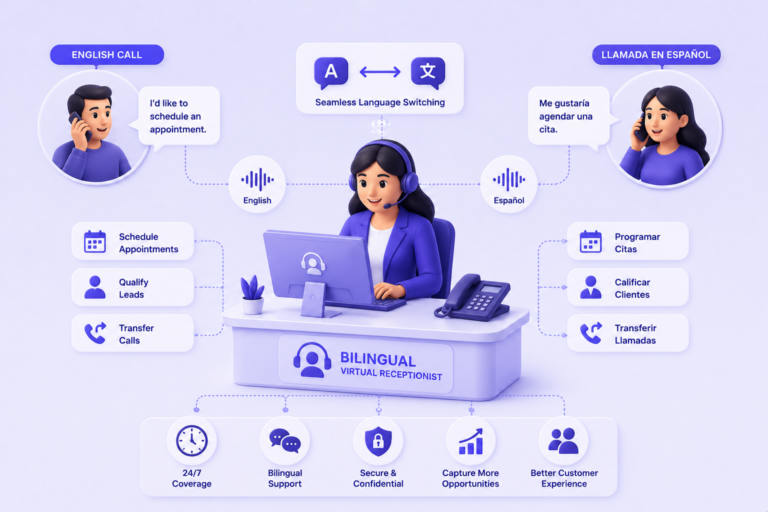
A customer calls a business and starts speaking Spanish. The person who answers only speaks English, so the caller struggles to explain what they need, gets frustrated and hangs up. They call the next business on their list instead. A bilingual virtual receptionist is built to prevent that moment. It answers calls in English and Spanish, following the same business rules in either language, so a caller's preferred language never decides whether they get help. This guide covers how bilingual call handling actually works in the U.S. market: language routing, scheduling, lead qualification, transfers, 24/7 coverage, pricing and what to check before choosing a provider.
Having someone on staff who speaks Spanish is not the same as running a real bilingual reception service. The receptionist needs to follow the business's approved call-handling process in both languages, not just translate words on the fly.
Some callers ask for Spanish directly. Others simply start speaking it and the receptionist responds in kind. The exact process for identifying language preference depends on how the provider staffs calls and what call system routes them, so it is worth asking a provider how this actually works in practice.
Greetings, common questions, call routing, appointment rules and escalation instructions should stay consistent whether the call happens in English or Spanish. If a Spanish-speaking caller gets a shorter or less accurate version of the process, the bilingual service is not doing its job.
A useful bilingual receptionist service goes past picking up the phone. It can include call transfers, appointment scheduling, message taking, lead qualification, answering common customer questions and logging follow-up requests, all handled the same way regardless of which language the caller uses.

Here is roughly what happens during an incoming call, though the exact steps depend on the business:
Not every provider performs all seven steps and some businesses only need a few of them. The structure matters more than the exact number of steps, since it shows whether bilingual call handling is a real workflow or just two people answering phones in different languages.
Bilingual coverage tends to matter most where a meaningful share of callers prefer Spanish, not necessarily for every business.
Spanish is the most common non-English language spoken at home in the U.S., with about 44.9 million people age five and older speaking it, according to the Census Bureau's 2024 American Community Survey. That does not mean every business needs bilingual coverage, but it explains why the option matters across so many industries.
A good bilingual workflow defines what happens once a caller needs a person, an appointment, a quote, or an urgent response, not just a friendly greeting.
Calls should route to a specific employee, department, location, or on-call staff member based on instructions the business sets in advance. Vague transfer rules lead to callers bouncing between people, in either language.
Scheduling depends on calendar access, defined appointment types, business hours, available slots and clear cancellation and confirmation steps. These rules should work exactly the same way in Spanish as they do in English.
Bilingual lead qualification should rely on questions the business has already approved, not judgment calls made on the spot. A receptionist deciding on their own whether a lead is worth passing along is a risk in any language.
A provider advertising "bilingual support" is not the same as one that staffs both languages during every hour a business actually needs. Coverage can vary across business hours, evenings, weekends, holidays and overnight calls and Spanish availability does not always match English availability hour for hour.
Before assuming a plan covers everything, confirm which languages are available at which times, whether Spanish support is staffed by live agents or something more limited and what happens to a Spanish-speaking caller when a bilingual agent is not available. Do not assume 24/7 means both languages are covered around the clock unless the provider confirms it directly.
There is no single industry-wide price for a bilingual virtual receptionist, since cost depends on the monthly plan, call volume, minutes or number of calls, coverage hours and whether bilingual staffing is included or an add-on. The final bill can also be impacted by appointment scheduling, lead qualification, call transferring, software integrations and custom scripts.
Before you sign, ask providers directly: Is bilingual coverage included in the base plan or is it extra? Is support in Spanish 24/7? Are calls billed by minute or by call? Are transfers charged separately? Are appointments included? Are there setup fees or a monthly minimum? Getting clear answers here matters more than comparing advertised starting prices.
Read our Legal Virtual Receptionist vs. In-House Receptionist Guide.
Choosing a provider comes down to a few concrete checks rather than picking whichever one markets itself as the best.
This is a great option for businesses that get frequent calls in both languages, have a small front-desk staff, miss calls after hours, need to book appointments or qualify leads on multiple U.S. markets in both English and Spanish.
It is less necessary for a business with low call volume and dedicated bilingual staff already handling calls well internally. The clearest next step is comparing your own call volume, language demand and coverage gaps against your current receptionist costs, then exploring a bilingual receptionist option built around consistent workflows in both languages.
What is a bilingual virtual receptionist?
A bilingual virtual receptionist will answer business calls in English and Spanish, following the business’s approved process for greetings, scheduling, transfers and information collection in either language.
Can a bilingual virtual receptionist answer calls in Spanish?
Yes, but the amount of Spanish language handling will depend on the provider and the particular service you choose. Some provide full intake and scheduling in Spanish, while others provide more limited support.
Can bilingual virtual receptionists schedule appointments?
Several services offer appointment scheduling if the calendar access and business rules are already set up. Make sure you ask whether scheduling is part of the base plan or charged separately.
How much does a bilingual virtual receptionist cost?
Pricing depends on call volume and coverage hours, as well as whether or not bilingual staffing, scheduling and integrations are available. Price is not an industry-wide rate, so please confirm current pricing directly with providers.
Can a bilingual virtual receptionist work 24/7?
Some providers offer 24/7 coverage, but you want to check if Spanish and English is available during each of those times, not just take the marketing language at face value.
Is a bilingual virtual receptionist useful for a small business?
This can be especially true for small businesses with limited staff that regularly receive calls in Spanish or miss calls when they are out of business hours.

