 SmartHub
 Automation
 Appointment Scheduler
 Lead Management
 Dashboard & Reports
 Task Management
 Communications Hub
 Managed chat
 Voice Receptionist
 Appointment scheduling
 Retainer signing
 Home services
 Lawyers and firms
 Medical services
 College admissions
 Real estate agents
 Marketing agencies
 About
About Partner program
 Estimate Your ROI
 Case Studies
 Blog
Blog FAQs
FAQs Login
LoginCase Study: Faster Admissions Response With AI Assistance




Products
Industries
Company
Resources

Fall applications don't wait for business hours. A prospective student emails at 11 p.m. asking about deadlines, then waits three days for a reply. By the time someone gets back to her, she's already filled out forms for two other schools and moved on with her decision. That was the pattern one mid-sized university kept running into every recruitment cycle, and it's what finally pushed them toward admissions response with AI assistance as a fix for a pipeline that kept leaking applicants right when it mattered most.
The team wasn't short on effort. They were short on hours in the day. Staff answered what they could, prioritized what looked urgent, and hoped the rest wouldn't slip through the cracks. Some of it did anyway.
Staff knew slow replies were costing them students, but there simply weren't enough hands to keep up with the volume coming in. Deadlines made everything worse, and families noticed the silence. Some just stopped waiting around for an answer that might never come.
Admissions automation stopped being a "someday" project once it became obvious the inquiry volume wasn't going to shrink on its own, and the cost of waiting kept showing up in enrollment numbers.
For a closer look at why speed matters in this space, see 5 reasons college admissions chat captures more leads.
The university brought in Blazeo to run an AI-driven live chat and chatbot setup built specifically around admissions traffic. The idea wasn't complicated: answer fast, hand off anything that actually needed a person, and stop making applicants wait on hold or sit in an inbox for days.
Blazeo's chatbot for college admissions was trained directly on the school's own admissions material, so answers stayed consistent no matter which channel a student used to reach out. Once it was live, it handled:
With Blazeo running in the background, the admissions team stopped having to choose between speed and accuracy. Both happened at once, at any hour of the day or night, without anyone pulling a late shift to make it work.
More on this approach in Chatbots in Admissions: 7 Lead Gen Hacks.
Curious what this could look like for your office? Check out Blazeo's college admissions solution and start answering prospective students in minutes instead of days.
Getting the system live didn't require tearing anything down and starting over. The team worked with Blazeo on a short, focused runway, aiming to have everything ready well before the next wave of applicants showed up.
This kind of setup has become increasingly common among universities using AI admissions platforms that want faster recruitment without adding more people to payroll. It's less about replacing staff and more about making sure their time goes toward the questions that actually need a human.
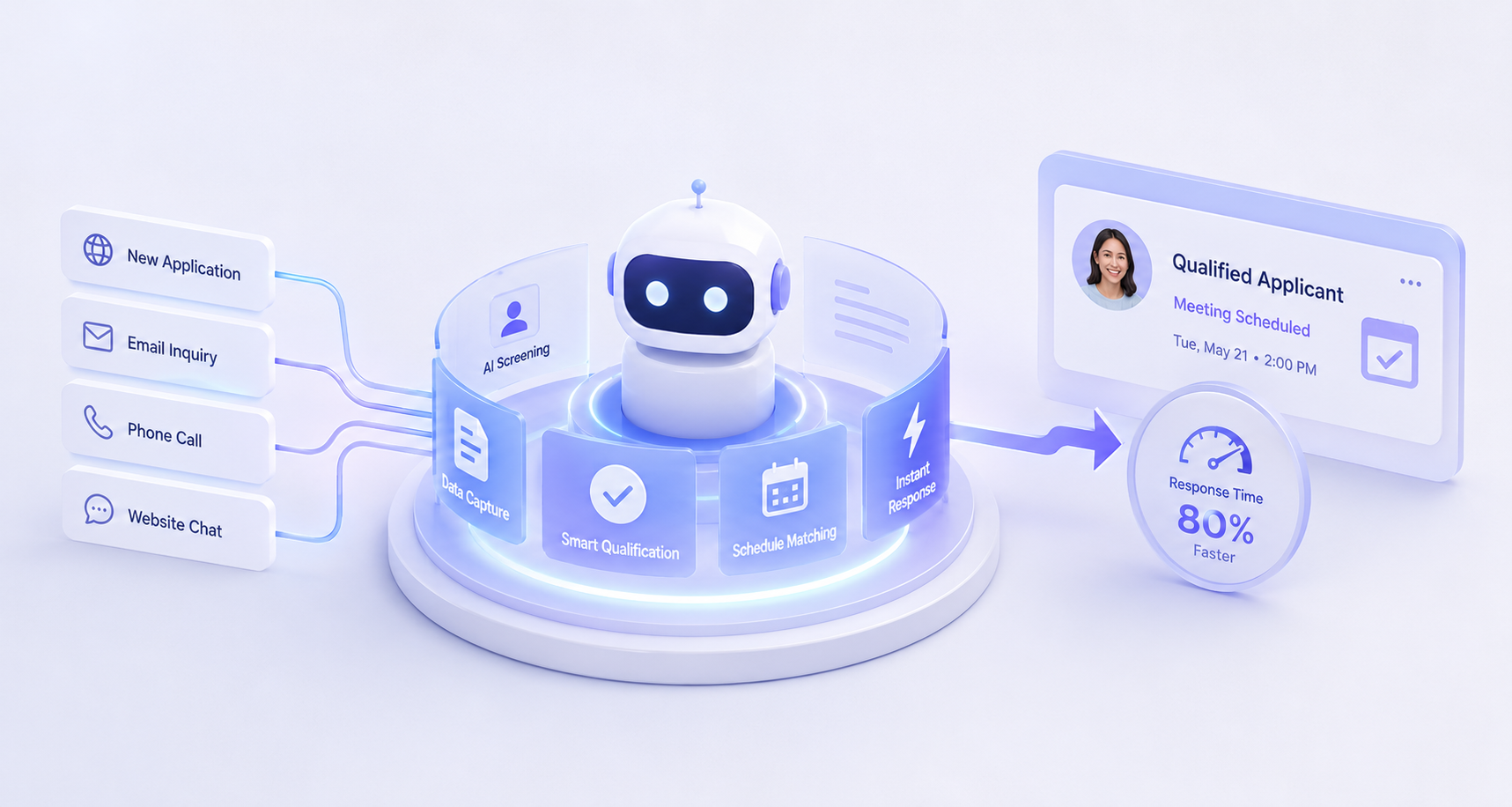
By the end of the first full cycle, the shift was hard to miss. Response times fell sharply, staff got hours back in their week, and students stopped sitting in silence waiting on a reply that used to take days.
These numbers are exactly what admissions response with AI assistance was supposed to deliver: faster replies without losing the personal touch that actually matters in admissions decisions. Blazeo gave staff room to focus on the students who needed real judgment calls, not the ones asking about a deadline they could've looked up themselves.
Worth a look too: AI Chatbot for Healthcare, which shows a similar pattern playing out in another high-volume, high-stakes field where timing matters just as much.
"We were losing applicants just because we couldn't get back to them fast enough, and it wasn't for lack of trying. Blazeo fixed that almost immediately. Now every question gets an answer right away, and our staff can actually focus on the students who need us most instead of chasing routine questions all day."
This case lays out a problem most admissions offices already know well: too many questions coming in, not enough people to answer them all in time. AI chatbot tools for higher education like this one don't just speed things up on paper. They keep applicants engaged long enough to actually finish what they started, instead of drifting toward a school that answered faster.
Schools looking at similar tools should check for a platform trained on their own content, capable of handing off complex cases cleanly, and easy to plug into systems they're already using. Response speed isn't a nice-to-have feature anymore. In a lot of cases, it's the difference between an enrolled student and one who quietly applied somewhere else instead.
Want faster admissions response at your school? Request a Blazeo demo and see what AI assistance could do for this cycle's recruitment numbers.