 SmartHub
 Automation
 Appointment Scheduler
 Lead Management
 Dashboard & Reports
 Task Management
 Communications Hub
 Managed chat
 Voice Receptionist
 Appointment scheduling
 Retainer signing
 Home services
 Lawyers and firms
 Medical services
 College admissions
 Real estate agents
 Marketing agencies
 About
About Partner program
 Estimate Your ROI
 Case Studies
 Blog
Blog FAQs
FAQs Login
LoginLead Generation for Attorneys: Proven Strategies for Law Firms in 2026




Products
Industries
Company
Resources

The phone rings less than it used to. People visit your website, but they don't book a consultation. Meanwhile, the firm down the street seems to sign every case that walks in. Ads cost more each year, more firms are competing for the same clients and AI search is changing how people even look for a lawyer.
Lead generation for attorneys simply means finding people with legal problems and helping them become paying clients. This guide walks through local SEO, paid ads, AI answer content, bar rules and the intake work that ties it all together, so you leave with a real plan instead of a random list of tips.
No single tactic works for every type of practice. But the right mix usually does and that's what we'll build here. Let's start with where clients actually come from today.
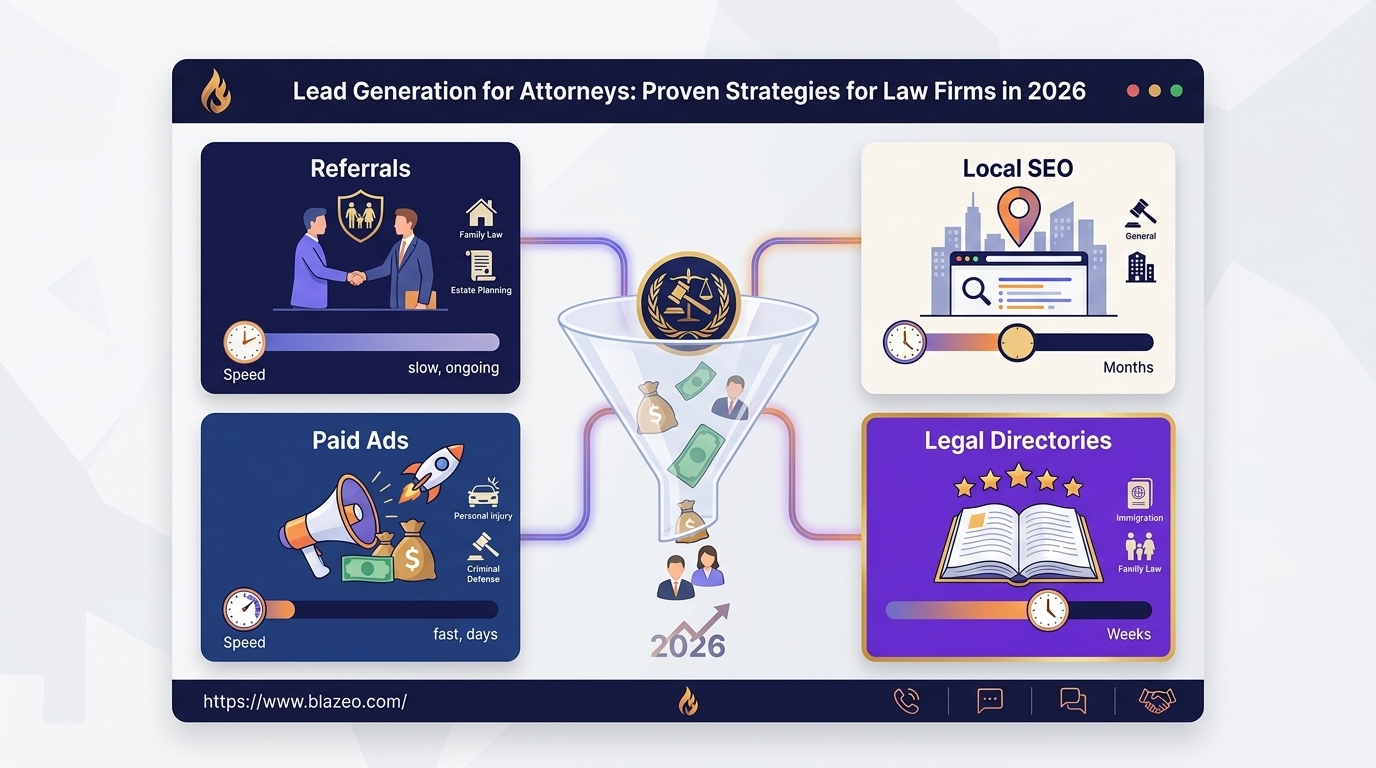
Most clients come from referrals, local search, paid ads, legal directories and online reviews. The strongest firms rarely lean on just one of these. They mix a few together and that mix looks different depending on your practice area.
| Channel | Best For | Speed of Results | Typical Practice Areas |
| Referrals | Repeat trust, reputation | Slow, ongoing | Family law, estate planning |
| Local SEO | High-intent searchers | Months | Most practice areas |
| Paid ads | Fast lead volume | Days | Personal injury, criminal defense |
| Directories | Visibility, reviews | Weeks | Immigration, family law |
Referrals still matter. But on their own, they're rarely enough to keep a firm growing.
Former clients, other attorneys and local professionals like accountants send some of your steadiest leads. The catch is that referrals grow slowly and they depend a lot on how well you treated the last client who walked out your door.
People type their legal problem straight into Google, or now they ask an AI tool for help instead. Your firm needs to show up in both places, not just one, because more people are starting their search with a question instead of a keyword.
Google Ads, Local Services Ads and social platforms can bring in leads within days. The catch here is cost. Paid leads only pay off if your team can actually keep up with them once they come in.
Sites like Avvo, Justia and FindLaw, plus local bar or chamber groups, still send real traffic for several practice areas. Think of these as one piece of your overall presence, not something that replaces your own website.
Local SEO puts your firm in front of people who search things like "attorney near me" or "divorce lawyer in Tampa." For most firms, this is the cheapest channel with the highest intent behind it. The local pack, that box with three map listings near the top of Google, usually decides who gets seen first.
A strong Google Business Profile needs the right category, correct hours, your actual services listed, real photos and a name, address and phone number that match everywhere else online. This is work you could realistically start this week, even on your own.
Claim your listing, verify it and fill in every field Google gives you: category, hours, services and service area. An incomplete profile ranks worse and it gives potential clients one more reason to move on to the next firm.
Here's a simple way to plan your pages: list your practice areas down one side and your target cities across the top. Each pairing becomes a page idea, like "DUI lawyer Phoenix." Start with three or four combinations, not every city at once.
Ask happy clients for a review soon after their case ends, while the relief is still fresh in their mind. Reply to every review you get, but never mention case details or confirm that someone was actually your client.
Your name, address and phone number should match exactly across your website, directories and social pages. When these don't match, it confuses both people and search engines and it can quietly hurt your local rankings over time.
Paid ads bring fast leads, but they only pay off when your team answers quickly and tracks what happens next. Cost per click swings a lot depending on your practice area and city, so treat any number you see online as a rough guide, not a promise.
Here's a rule worth building your whole process around, the 5-Minute Intake Rule: answer every new lead within five minutes during business hours. Why does speed matter this much? Because that person is probably contacting more than one firm right now and whoever calls back first usually wins the consultation.
When a lead comes in, do this:
These work on a pay-per-lead model and verified attorneys get a "Google Guaranteed" style badge next to their listing. Availability and verification steps change by state and practice area, so check current requirements before setting a budget.
Put your budget behind urgent phrases, like "DUI lawyer near me tonight," and build out your negative keywords carefully. This keeps you from paying for clicks from people who were never actually going to hire anyone.
A lead that sits untouched for two hours has already gone cold. Running ads without fast intake behind them is really just paying for expensive voicemails nobody will ever return.
AI tools like Google AI Overviews and ChatGPT pull short, clear answers from pages that show real expertise. Law firms that write plain answers to real client questions are the ones getting picked up. This is where most competitors fall short and it's quickly becoming one of the more dependable paths for law firm lead generation in 2026.
Here's how it works in practice: pick a question real clients actually ask, answer it in 40 to 60 words, add more detail underneath, mark up the page with schema and show who the attorney behind it actually is. Take a question like "how long does a personal injury claim take." A good opening answer might say it depends on the state and how complex the case is, but many claims settle within several months to a year.
Start every section with a plain, standalone answer before you add any background. This is the exact format AI tools tend to pull from, so it works double duty for both human readers and machines.
Article, FAQPage, LegalService, Attorney and Person markup all help machines understand what's actually on your page. Google's FAQ rich results are limited these days for most sites, but this structured data still helps AI tools make sense of your content.
Keep your name and bio the same everywhere: your website, your bar profile, Google Business Profile, Avvo and LinkedIn. This kind of consistency helps AI tools confirm who you really are and that raises your odds of getting cited.
Laws change from state to state and a page that actually names the state and its real rules will almost always beat generic advice. Generic content is easy to write, but it's just as easy for AI tools to skip right past.
None of this guarantees you'll get cited by an AI tool. It just genuinely improves your odds.
Every state bar in the US has its own advertising and solicitation rules and most of them build on ABA Model Rules 7.1, 7.2 and 7.3. Ads need to be truthful, claims about results need real care, paying for referrals is restricted and reaching out to people directly has firm limits.
A few real examples: New York requires an "Attorney Advertising" label on ads that qualify, several states want disclaimers next to case results and states like Florida have filing or review steps for certain kinds of ads. These rules vary enough between states that you should check your own state's current requirements before launching anything new.
Always check your own state bar's current rules before you launch a campaign.
A legal CRM stores every lead you get, tracks the follow-up and shows you which channels actually turn into signed cases, not just clicks. Without one, you're really just guessing at what's working.
Here's the basic flow: a lead comes in, gets a reply, books a consultation, signs a retainer and gets tagged by source so you know where it came from. Look for a CRM with intake forms, automatic follow-up, e-signature, call tracking, reporting by source and secure handling of client data. Clio Grow, Lawmatics, Filevine and MyCase are a few well-known names worth comparing, though features change often, so check current capabilities directly before choosing.
Automatic follow-up and call tracking tend to matter most, since these catch leads that a busy front desk might otherwise miss entirely.

| Metric | What It Tells You | How to Track It |
| Cost per lead | What you pay to generate interest | Ad spend divided by leads |
| Consultation rate | How many leads book a meeting | Consultations divided by leads |
| Signed case rate | How many consultations convert | Signed cases divided by consultations |
| Cost per signed case | Your real return on spend | Total spend divided by signed cases |
| Lead response time | How fast your team follows up | Time from lead to first contact |
Cost per signed case matters more than cost per lead. A channel with cheap leads that rarely convert can end up costing you more than one with pricier, better-qualified leads.
Want a hand building this system? Talk to our team about a free lead audit.
Build up your local visibility with a complete Google Business Profile, write clear answers to common client questions, run targeted ads for your practice area and follow up within five minutes every time.
There's no single winner here. It really depends on your firm size, practice area and budget. Compare intake forms, automation, reporting and security features, since solo attorneys and larger firms usually need different setups.
Lean into referrals, reviews, local search, helpful content and fast replies to new inquiries. Instead of chasing every channel at once, pick one or two and actually get good at them first.
Paid ads can bring leads within days of launching. Local SEO and content usually take three to six months to build real traction. How fast you see results depends on your competition and your practice area.
The rules change by state, so there's no one answer that fits everyone. Paying for advertising is generally fine, but paying for a referral is restricted in many places, so check your state bar's current rules first.
Referrals, local search, paid ads and AI answer content all play a part, but none of them work well without fast, disciplined intake behind them. Start with what you can fix this week: clean up your Google Business Profile, put the 5-Minute Intake Rule into practice and write one strong answer page for your top practice area.
None of this happens overnight and that's okay. Showing up consistently beats any single big push. Ready to build a system that actually tracks what's working for your firm? Request a lead generation review with our team.

