 SmartHub
 Automation
 Appointment Scheduler
 Lead Management
 Dashboard & Reports
 Task Management
 Communications Hub
 Managed chat
 Voice Receptionist
 Appointment scheduling
 Retainer signing
 Home services
 Lawyers and firms
 Medical services
 College admissions
 Real estate agents
 Marketing agencies
 About
About Partner program
 Estimate Your ROI
 Case Studies
 Blog
Blog FAQs
FAQs Login
LoginIs an AI Receptionist Legal in the US? AI Disclosure and Call Recording Rules by State




Products
Industries
Company
Resources

Yes, in most cases. An AI receptionist is legal in the US when you follow call recording consent laws, disclose AI where state law requires it and protect caller data.
It's 6:45 p.m. and your phone is still ringing. Your team has gone home, voicemail is full and every missed call is a customer who may call a competitor next. You can't staff the phones all night.
So you look at an AI voice agent, then pause. Is an AI receptionist legal, or are you walking into a fine, a lawsuit, or a privacy complaint? Plenty of owners hit this exact wall.
This guide gives you the short answer, the disclosure rules, the recording rules by state and the questions to ask any vendor. It shares general information and isn't legal advice.
Is an AI receptionist legal? Yes, in most cases. No federal law bans a business from using an AI voice agent to answer its own calls and no state bans it outright, as far as current sources show.
The rules that do apply cover call recording, AI disclosure and outbound calling. Those depend on your state and who starts the call.
Treat it like a human receptionist. A person can answer your phones and take messages. The law cares about how calls are recorded, what callers hear and where their data goes.
AI answering service legal requirements come down to four habits. You're in good shape when you:
The next sections break down each rule, starting with disclosure.
AI receptionist disclosure requirements depend on which way the call goes and where the caller lives.
AI receptionist disclosure requirements are thin at the federal level. As of October 2026, no federal rule makes you announce AI on inbound calls.
The FCC proposed AI call rules in 2024, but they target outbound calls and aren't law. It also noted that TCPA requirements don't extend to technology that answers inbound calls.
Disclosing anyway builds trust and heads off complaints.
AI phone call disclosure laws get stricter when your AI places the call, because the TCPA applies. That's the federal law on robocalls and telemarketing.
In February 2024, the FCC ruled that AI-generated voices count as artificial voices. You usually need the caller's consent before placing those calls.
Answering a call the customer made isn't the same thing. For callbacks and follow-up texts, get consent first.
Online posts often cite a Texas AI voice disclosure law with a 30-second deadline. We couldn't confirm it. The enacted text of SB 140 expands telemarketing rules to texts and doesn't mention a timer.
Texas' separate AI act, HB 149, requires disclosure by government agencies and healthcare services. Say you're an AI in your first sentence and timing never becomes a question.
AI-generated voice disclosure rules are patchy, so each state sets its own trigger.
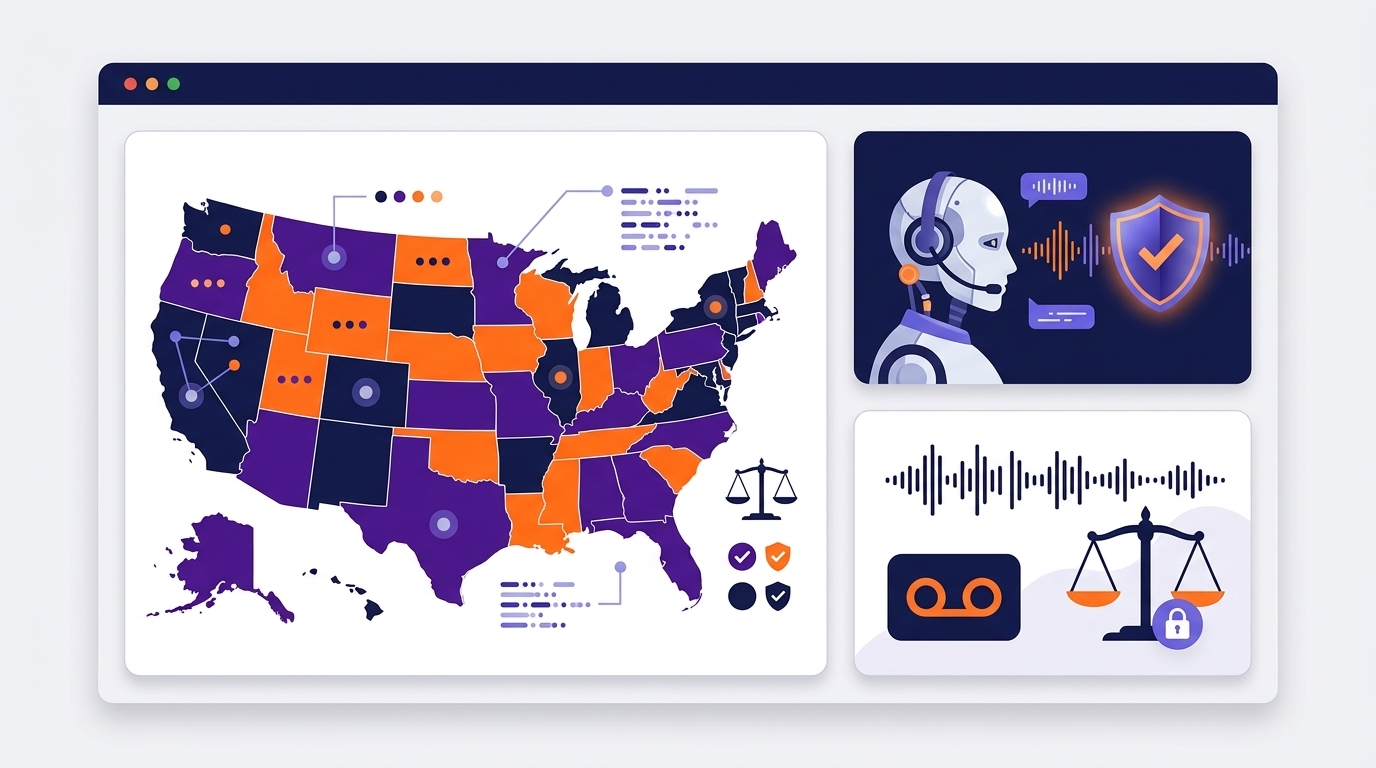
AI receptionists usually record or transcribe calls, so state recording laws apply no matter who answers. That makes AI receptionist call recording a legal question from the first ring.
One-party consent means one person on the call, including you, can agree to a recording. All-party consent means everyone must agree.
Federal law follows one-party consent. Roughly 11 to 12 states require all-party consent and the table below lists the ones people cite most.
| State | Rule | Notes |
| California | All-party | Penal Code 632 and 632.7 |
| Connecticut | Civil all-party for phone calls | Recorded notice at start works |
| Delaware | Arguably all-party | Law is unclear |
| Florida | All-party | Statute 934.03 |
| Illinois | Generally all-party | Private conversations |
| Maryland | All-party | Private talks |
| Massachusetts | All-party | Secret recording is barred |
| Montana | All-party | Based on knowledge, not consent |
| New Hampshire | All-party | Consent can be implied |
| Pennsylvania | All-party | Statutes 5703 and 5704 |
| Washington | Generally all-party | Announcing the recording counts |
Nevada also requires all-party consent on phone calls, based on a court ruling. Check Justia's 50-state survey for the statutes. Rules change. Confirm with your attorney.
When your office and the caller sit in different states, follow the stricter rule. The California Supreme Court has applied California's all-party rule to calls with people in one-party states.
| Call type | AI disclosure | Recording notice | Main law to check |
| Inbound, business hours | Best practice, required in some states | Yes, in all-party states | State recording statutes |
| Inbound, after hours | Same | Same | Same |
| AI hands off to live agent | Tell the caller before transfer | Notice stays active | State recording statutes |
| Outbound callback or text | Often required | Yes | TCPA plus state law |
Put the recording notice and the AI disclosure in the same opening sentence.
Some industries carry extra duties on top of state call rules. AI receptionist compliance looks different for each.
ABA Formal Opinion 512, issued July 29, 2024, says lawyers need informed consent before entering client information into self-learning AI tools.
Rule 1.18 protects what prospective clients share, even before they hire you. Intake should collect facts and never give legal advice. Law firms can see how Blazeo handles legal intake.
Patient calls can include protected health information, so HIPAA can apply. Protected health information means details about a person's health or care.
Ask any vendor how it protects patient data and whether it signs a business associate agreement. Practices can see how Blazeo supports medical services.
Emergency calls need clear routing, so decide in advance which ones go straight to a person. Add a recording notice and get consent before any text follow-up. See how Blazeo routes home service calls.
The opening seconds do most of the legal work. One short greeting can cover your AI-generated voice disclosure and your AI receptionist call recording notice together.
A solid greeting has five parts:
General business:
"Thanks for calling Harbor Plumbing. I'm an AI assistant and this call is recorded. If you'd rather talk to a person, just say so. How can I help today?"
Law firm or clinic:
"You've reached Alvarez Law. I'm an AI assistant and this call is recorded. I can't give legal advice, but I can connect you with a person. What's happening?"
If a caller asks, confirm you're an AI. Never claim to be human. Keep the notice short and ask your attorney to review the final wording for your state.
Before you sign, test any vendor against the basics of AI receptionist compliance. These seven questions are quick to ask and the answers tell you a lot.
Strong AI phone answering compliance starts with a vendor that answers these clearly.
Blazeo pairs conversational Voice AI with trained US-based live agents, so callers can reach a person when they want one.
You set the call flows, scripts and approved responses. Calls can escalate to a live agent with the context the AI collected and spam gets filtered. Coverage runs 24/7.
Explore Blazeo's AI answering service with live agents, then request a demo to see the greeting and handoff in action.
Do I have to tell callers they're talking to an AI?
No federal rule requires it on inbound calls today, but some states do in certain cases. Telling callers up front is the safest habit, so say it in your first sentence.
Can an AI receptionist record my calls?
Yes, if you follow the recording consent laws that apply to the call. In all-party states, everyone must agree, so give a clear notice at the start before any recording begins.
Is an AI receptionist legal for law firms?
Yes, but firms carry extra duties. Opinion 512 calls for informed consent before client information enters self-learning AI tools and Rule 1.18 protects prospective clients. Keep intake to facts and skip legal advice.
Do AI answering services need caller consent to record?
Yes, where state law requires it. One-party states accept your own consent and all-party states need every caller to agree. A spoken notice at the start often covers it. Confirm with your attorney.
Can an AI receptionist give legal or medical advice?
No. Set it up to collect facts, answer approved questions and book appointments. Sticking to approved responses keeps AI phone answering compliance easier and protects callers from wrong answers.
What happens if a caller asks for a human?
The best setup moves the call to a live person promptly. Never pretend to be human and pass along what the AI collected so the caller doesn't repeat it.
An AI receptionist is legal in most cases. Disclose AI, record with a clear notice and check the extra rules for your industry. Then choose a vendor that makes AI receptionist compliance easy to follow.
You can answer every call and still stay on the right side of the law. Laws change, so recheck your state's rules each year and ask your attorney.
Request a demo to hear how Blazeo sounds.

