 SmartHub
 Automation
 Appointment Scheduler
 Lead Management
 Dashboard & Reports
 Task Management
 Communications Hub
 Managed chat
 Voice Receptionist
 Appointment scheduling
 Retainer signing
 Home services
 Lawyers and firms
 Medical services
 College admissions
 Real estate agents
 Marketing agencies
 About
 Partner program
 Estimate Your ROI
 Case Studies
 Blog
 FAQs
 Login
Answering Service for Roofing Companies: 9 Things to Verify Before You Hire




Products
Industries
Company
Resources

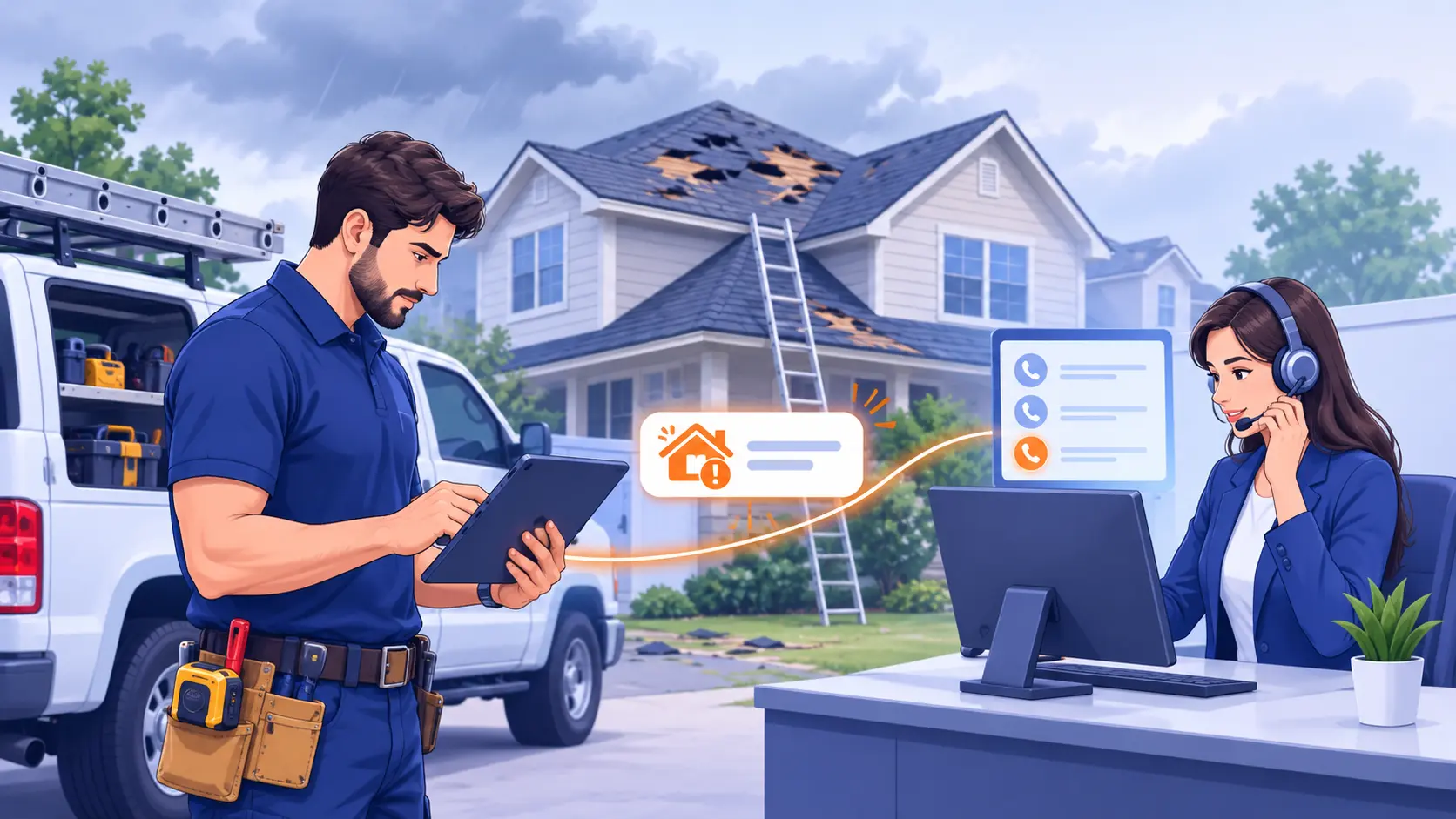
A hailstorm just rolled through town, and your phone won't stop buzzing. Your crew is on a steep pitch, nobody can answer, and the calls are heading to voicemail while homeowners keep dialing the next roofer.
Homeowners with a leak or a damaged roof often call several contractors and book the one who answers. Picking an answering service for roofing companies sounds easy, until the first storm shows you which ones can't keep up.
Below are nine things to verify before you hire, so you don't sign with a service that sounds great and fails in storm season. The list works for AI and human teams alike. First, what does the service handle?
This kind of service answers your inbound roofing calls, asks a set list of questions, and sends you a clear summary of each one. Think of it as a virtual front desk that never leaves the phone.
Some roofing answering services only take a message. Better ones qualify the lead and book the inspection, so your estimator starts the day with a real appointment instead of a name and a phone number.
Most of what comes in falls into a few familiar types, and a good service sorts them from the first minute:
Unlike most trades, roofing calls often arrive in bursts right after a storm, which is why capacity matters so much.
Homeowners in a roof emergency call fast, call many, and pick the first roofer who sounds ready to help. If your phone rings out, the next roofer on the list may get the job.
Roofing is different because urgency is high, jobs are large, and a storm event brings many competing contractors into the same neighborhood at once. A roofers answering service has to win those first minutes.
According to Invoca's July 2026 benchmark report, a person answered only 52% of calls to home services businesses, and calls that go unanswered often end up with the next company in the search results.
Calls usually slip through at the same moments:
Take this example, not a statistic: if three missed storm calls could each have become a $15,000 roof replacement, that's $45,000 in jobs you never got to quote.
The nine checks below show how to tell which services can actually catch those calls.
Storm season is when an answering service gets tested, so the first four checks cover capacity, coverage, urgent calls, and local knowledge. Each check is numbered, so you can score vendors one by one.
Ask how many simultaneous calls the roofing call center can take after a hail event or hurricane. Then ask what happens when every line is busy, because you want clear overflow rules and no busy signals.
Verify by asking: If 50 calls arrive in 10 minutes, how many get answered live?
A roofer phone answering service that truly covers 24/7 picks up live at 2 a.m., while a weaker one sends the call to voicemail. Ask for proof of coverage across nights, weekends, and holidays.
Verify by asking: Who answers a call at 2 a.m. on a holiday weekend, and can I hear a sample?
Ask how the service handles an active leak, a tree on a roof, or fresh storm damage. You want a clear urgent path that alerts your on-call roofer by call and text, plus basic, non-technical guidance for the caller.
Anyone in immediate danger should be told to call 911 first.
Verify by asking: What happens, step by step, when a caller says water is coming through the ceiling?
Verify the service knows your service area, zip codes, and local storm patterns. Hail regions and hurricane coasts call for different intake questions, such as impact damage versus wind and water.
Verify by asking: Which zip codes and storm types have you set up for roofers like us?
A good call only helps if the right details reach your estimator fast. These four checks cover what the agent asks, what it records, and how quickly you get it.
A strong script captures the address, roof type, roof age, damage type, whether a leak is active, and the best callback time. A generic home services script can miss much of that.
Verify by asking: Can I see the intake questions you'd use for a roof inspection request?
Ask whether agents can note the claim status, carrier name, and adjuster visit date without giving claim advice. The service should never promise coverage or approval, because that's between your customer and their insurer.
Verify by asking: What do your agents say if a caller asks whether insurance will cover the roof?
Verify the service can book inspections straight onto your calendar and send confirmation texts. Reschedules and no-show reminders matter too, since they keep your estimator's day full without extra phone calls from your office.
Verify by asking: Which calendar tools can you book into, and do callers get a confirmation text?
Ask how fast summaries arrive, in what form, and whether transcripts and recordings come with them. Text, email, and CRM entry are common options, so confirm which ones your team can actually use.
Verify by asking: Within how many minutes of a call do I receive the summary, and where?
What a good roofing lead summary contains:
| Field | Why it matters |
| Address and roof type | Sets the inspection scope |
| Leak status | Decides how urgent the visit is |
| Damage type | Prepares your crew |
| Claim notes | Helps with adjuster timing |
| Callback time | Avoids missed return calls |
The ninth check is the paperwork, because a great call experience can sit inside a bad contract. Ask for pricing, term, and privacy details in writing before you commit.
Services usually bill per minute, per call, or through a monthly plan. Ask about overage fees and whether storm surges raise the price, since your busiest week shouldn't bring your biggest surprise.
Check the contract length, the cancellation terms, and whether a trial period is available. Then ask how customer data is stored and who can listen to recordings.
Call recording consent laws vary by state, and text follow-ups should respect consent rules too. Ask the vendor how they handle this, and check the Justia 50-state survey for background. This isn't legal advice.
If the service uses AI, callers should be told so clearly wherever state rules require it. Watch for these red flags:
AI picks up instantly and handles many calls at once, humans handle odd or emotional calls better, and a hybrid mixes both. The right choice depends on how your calls actually arrive.
| Factor | AI | Human |
| Surge capacity | Many calls at once | Limited by team size |
| After-hours coverage | Always on | Depends on staffing |
| Consistency | Same script every call | Varies by agent |
| Upset callers | May need a handoff | Strong with judgment |
| Cost pattern | Often lower per call | Often higher per call |
A hybrid works best when AI handles intake and a person steps in for complicated claims or angry homeowners. A roofer virtual receptionist built this way keeps routine calls fast without losing the human touch.
A good roofer call center, human or AI, should also give you transcripts so you can review quality yourself.
Blazeo's home services answering solution combines AI with live agents, and you can hold it to the same nine checks.
Call the service yourself with a roof leak scenario and score what happens. Any answering service for roofing companies should pass this test before you trust it with a storm week.
Run the call in five steps, and write down what you hear:
Then score each of the nine checks as pass or fail:
| Check | A pass looks like | Pass or fail |
| 1. Storm-surge capacity | Overflow rules, no busy signals | ☐ |
| 2. 24/7 live coverage | Live answer at 2 a.m. | ☐ |
| 3. Emergency triage | Urgent alert to on-call roofer | ☐ |
| 4. Local awareness | Knows your zip codes and storms | ☐ |
| 5. Roofing intake script | Captures roof age, type, leak status | ☐ |
| 6. Insurance handling | Notes claim details, no promises | ☐ |
| 7. Inspection booking | Books and sends confirmation text | ☐ |
| 8. Instant handoff | Summary arrives within minutes | ☐ |
| 9. Contract and privacy | Clear terms in writing | ☐ |
A passing result is simple: the call is answered fast, the agent asks roofing questions, nobody promises coverage, and a summary lands within minutes.
When you're ready, compare Blazeo against your scorecard.
Services usually bill per minute, per call, or through a monthly plan, and storm surges can change the final bill. Ask for a written quote based on your expected monthly call volume, including overage fees.
Yes, when it's connected to your calendar. It can offer open times, send confirmation texts, and handle reschedules, so your estimator isn't playing phone tag with homeowners. Confirm this before you sign.
It can, if it offers live 24/7 coverage and an urgent alert path to your on-call roofer. Test both by calling at night with a leak scenario before you sign.
For standard intake and storm surges, often yes. AI handles routine questions and many calls at once, while complex claims or upset homeowners can be passed to a person if the handoff is set up well.
It can record claim details, such as the carrier, claim status, and adjuster visit date. It shouldn't give coverage advice or promise approval, because those decisions belong to the homeowner's insurer.
Setup is usually a short onboarding to configure your intake script, routing, and alerts, though timing varies by provider. Ask each provider for a specific timeline in writing, including when calls go live, before you sign.
Nine checks turn any answering service for roofing companies into a fair comparison, and a quick test call proves it. When you're ready, review Blazeo's home services page and see how a roofer virtual receptionist scores.

