 SmartHub
 Automation
 Appointment Scheduler
 Lead Management
 Dashboard & Reports
 Task Management
 Communications Hub
 Managed chat
 Voice Receptionist
 Appointment scheduling
 Retainer signing
 Home services
 Lawyers and firms
 Medical services
 College admissions
 Real estate agents
 Marketing agencies
 About
About Partner program
 Estimate Your ROI
 Case Studies
 Blog
Blog FAQs
FAQs Login
LoginHow AI Is Reshaping Business-to-Business Appointment Setting




Products
Industries
Company
Resources

Most sales reps don't talk about how much time disappears before a single meeting lands on the calendar. They chase leads who go quiet after two touchpoints, leave voicemails that nobody returns, and spend half their week doing work that has nothing to do with actually selling. Business-to-business appointment setting carries that invisible weight every single day, and most teams just accept it rather than fixing it.
Manual outreach is slow by design. It doesn't scale without additional staffing, it's inconsistent because it depends on who's having a good day, and it wears down your top reps faster than any missed quota ever will. AI changes that. It takes over the repetitive parts, surfaces the leads actually worth contacting, and keeps your pipeline moving without someone babysitting it every hour. In this blog, you'll see how AI fits into the appointment setting process, which practices hold up under real pressure, and when outsourcing the whole thing beats building it internally.
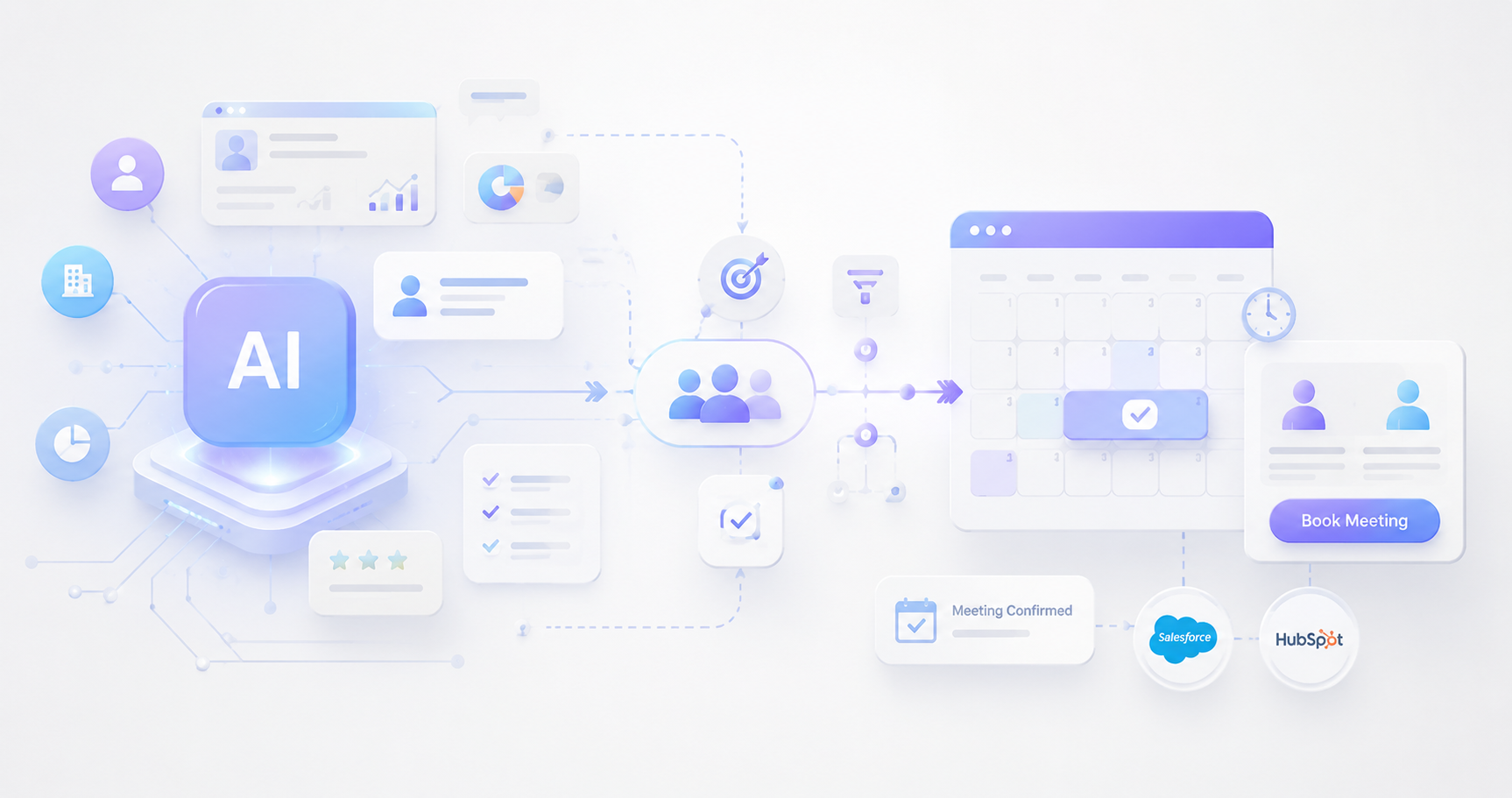
AI appointment setting uses artificial intelligence to handle lead scoring, outreach sequencing, and calendar booking without requiring a rep to manually touch every single step. Traditional outreach depends entirely on someone grinding through a list and hoping a prospect picks up. AI runs that same process in the background, continuously, without needing a motivational speech to keep going.
Old-school outreach runs on cold calls pulled from static spreadsheets, reps logging follow-ups one contact at a time, and gut-feel calls about who deserves a fifth touchpoint. That system produces effort. It rarely produces results you can count on week after week.
AI swaps that guesswork for behavioral scoring, trigger-based sequences, and scheduling logic built around real prospect signals. It figures out who shows genuine intent and times outreach around when those people actually respond. Your reps still do what they're good at: having the conversation, handling objections, and closing. AI just stops wasting their hours on everything that came before that conversation started.

Two things define how AI reshapes B2B appointment setting right now. How teams find and reach the right people. And how do they get those people on a calendar without chasing them across a dozen follow-up emails? AI works on both ends at once, and that's genuinely what separates it from the older tools most teams have already tried and abandoned.
Before a rep makes contact, AI appointment setting tools already narrow down who's worth reaching and why. They score leads based on behavioral signals: website visits, content downloads, email opens, repeat visits to a pricing page, company hiring trends, and activity patterns that suggest someone is actively shopping for a solution right now. Your team reaches people already showing interest rather than cold-contacting a list that might be six months stale.
Personalization at scale stops being a contradiction in terms. AI pulls job title, company name, recent business news, and industry-specific pain points into each message so it reads as if someone wrote it for one person rather than blasting it to five hundred contacts at once. That specificity lifts show rates and shortens the sales cycle because your rep talks to the right person from the very first touchpoint instead of spending two weeks working past gatekeepers to get there.
Once a prospect signals they're open to talking, scheduling shouldn't become its own obstacle. Appointment setting solutions powered by AI sync directly with rep calendars and surface live availability the moment a prospect responds positively. Nobody sends three emails negotiating a time slot anymore.
Automated reminders fire before every meeting without anyone setting them up manually each time. No-show rates drop when someone gets a reminder the day before and an hour before, rather than forgetting a call they booked ten days ago. The system books, confirms, and follows up without stopping, which means a prospect in a different time zone can lock in a call at midnight their time if that's when they finally have a free moment.
Most teams connect an AI tool, point it at a lead list, and wait for meetings to appear. That rarely works. AI appointment setting best practices come down to two things most teams underestimate: keeping automated outreach feeling as if it came from a real person, and knowing exactly when a human needs to step in before automation pushes a warm prospect away.
Automation without personalization is just a faster way to get ignored. Teams seeing real traction from AI appointment setting best practices treat personalization as a hard requirement built into every sequence from the start, not something they plan to improve once the basics are running.
Dynamic tokens for name, company, job title, and a pain point specific to that prospect's industry move reply rates noticeably. What separates decent outreach from genuinely good outreach, though, is trigger-based sequencing. A message that fires because a prospect visited your pricing page three times this week lands differently than one that fires because it's day four of a cadence and the system decided it was time. One feels relevant. The other reads like a mass email with a first name dropped in.
Tone across seniority levels matters more than people expect. In B2B appointment setting, a C-suite buyer and a mid-level operations manager respond to completely different communication styles. VP-level messages need to be short, direct, and anchored in business outcomes. Manager-level messages can carry more context. Running one template across both tiers quietly tanks reply rates, and nobody on the team understands why.
AI handles early-stage outreach better than any human team could at the same volume: prospecting, initial contact, follow-up sequences, and re-engagement after silence. Consistency and volume matter more than nuance at that point.
The moment a prospect sends a real reply, asks something specific, or shows any signal they're genuinely considering a meeting, a human needs to be in that conversation fast. That handoff is everything in a business-to-business appointment setting. Miss it by a few hours, and a warm prospect gets another automated message that makes it obvious nobody is paying attention. Nail it, and that conversation moves toward a booked meeting faster than almost anything else in the process.

The right tool doesn't have the longest feature list. It fits how your team actually operates day to day. Most teams choose the wrong appointment setting solutions because they make the call based on a polished demo rather than running the software against their real CRM data, their actual lead volume, and the follow-up process their reps genuinely follow, rather than the one that looks clean on a slide.
Before committing to anything, work through these honestly:
Appointment setting services from established providers go further by pairing tooling with human oversight that catches what pure automation misses. Blazeo works as a trusted business-to-business appointment setting partner that brings AI-driven outreach together with human-led follow-up, a pairing that outperforms software-only setups, especially for teams without internal capacity to manage and fine-tune a full outreach tech stack alongside everything else already on their plate.
Most growing teams hit this decision eventually. B2B appointment setting managed internally looks and operates very differently from handing it to a specialist, and the right call usually depends on where the business actually sits right now rather than where it hopes to be.
Running business-to-business appointment setting internally gives your team full control over messaging, training, and how the brand comes across on every outreach touchpoint. Your people know the product. They've heard the objections before. They navigate complex early conversations in ways someone who learned your offering last month genuinely can't replicate yet.
For companies in niche industries where technical depth shapes the conversation from minute one, keeping this function internal makes real sense. The trade-off is honest, though. Building a dedicated team takes longer than most budgets account for, costs more to sustain than the initial estimate, and hits a hard ceiling when pipeline demand spikes and there's no time to hire and train fast enough to keep up.
Cost is what gets most teams looking at outsourcing first. It's rarely the only reason they stay with it. Outsourced B2B appointment setting service providers bring tested scripts, proven multi-touch sequences, and setters who do this specific job every day. Your provider already did that work before your first campaign goes live, so your team skips the months it would take to figure it all out internally.
Scaling based on actual pipeline demand changes the math completely. When you need to double outreach volume next quarter, you don't write a job description or push back your timeline. You adjust with your provider and keep moving without any operational disruption.
At Blazeo, we handle the outreach, qualification, and follow-up end-to-end so your sales team only picks up conversations with prospects who are genuinely ready to talk. Fewer dead-end calls, more real pipeline, without the overhead of building and running the whole function internally.

Results don't show up in week one, and any provider that tells you otherwise sets you up for a rough start. AI appointment setting gets better as it gathers data from your specific audience, and the early stage focuses almost entirely on setup, integration, and building the foundation that makes everything after it actually work.
What B2B teams realistically see across the first 90 days:
The strongest appointment setting solutions keep getting better past that 90-day mark because the AI learns which message types convert in your market, which lead profiles respond fastest, and which sequences lose people after the second touch. For any team serious about a consistent pipeline, pairing a dedicated B2B appointment setting service with this process adds the human judgment layer that automation alone genuinely can't replicate. Once it matures, business-to-business appointment setting stops feeling like something your team works around and starts functioning like a system they trust.
Hire a human setter when your product needs real technical knowledge on the first call. Use software once your process is proven and you need a higher volume without the timeline and cost of adding headcount to get there.
In-house setters typically run $40,000 to $65,000 annually once salary, onboarding, and training are factored in. Outsourced providers charge per appointment or monthly retainer, which usually costs less for teams that don't need someone full-time.
Most outreach data puts it at six to ten touchpoints before a prospect commits. AI-assisted outreach brings that number down by contacting people during genuine high-intent moments rather than relying on cold timing and luck.
Clean data and a well-defined ideal prospect profile come first. Multi-channel outreach beats relying only on calls. Trigger-based sequences responding to actual prospect behavior consistently outperform fixed cadences that fire on a schedule regardless of what the prospect does.
Start with fit: Does this company match your target profile? Then look at intent signals like repeat visits, content engagement, or recent activity suggesting active evaluation. A genuinely qualified lead matches your criteria and shows real interest, not just a reachable phone number.
Track contact rate, show rate, and booked-to-closed ratio consistently. The contact rate tells you if outreach reaches real people. The show rate tells you if meetings are held. The booked-to-closed ratio tells you whether meeting quality actually moves revenue.
Outsourcing scales fastest without the delay of hiring and training cycles. Staying in-house means investing in AI tools that handle scoring and sequencing automatically, so individual rep capacity stops being the thing that limits pipeline growth.
A team booking 20 qualified meetings monthly with a 25 percent close rate and a $10,000 average deal produces $50,000 per month directly from the appointment setting function, before renewals or expansions get added on top.
AI isn't arriving someday. It works inside business-to-business appointment setting right now, and teams treating it seriously book more meetings with far less wasted effort. Better targeting, smarter follow-ups, a pipeline that moves even when your team is offline: those aren't promises, they're what teams already doing this actually see.
The right appointment-setting services pair smart technology with genuine human judgment, and the gap between a full pipeline and a frustrating one almost always comes down to striking the right balance. Now that you know how the process works end-to-end, the next step is to find a setup that fits your team and your goals. That's where real sales growth actually begins.
